Signed in as:
filler@godaddy.com
A recent article published by a major national online media outlet included numerous false, misleading statements about me and my former business, Romo Productions.
I was never homeless. I never lived in my car. I did not misrepresent my business. I did not engage in any unlawful conduct.
My company lawfully fulfilled government contracts using fully disclosed and approved subcontractors, in accordance with standard industry practices that are widely used in the apparel sector.
All subcontractors were registered, verified, and known to the government. All facilities were inspected. All contracts were properly performed. At no time has any government agency found wrongdoing by me or my company.
The article relies heavily on unverified claims from a former subcontractor with a personal grievance. These claims were published without reference to the contemporaneous documentation available.
The article also improperly uses personal information and unrelated creative work to sensationalize and stigmatize, rather than report accurately. This framing is misleading and harmful.
These false statements have caused serious damage to my reputation, professional opportunities, music career, and personal well-being.
It is also important to note that the business referenced in this article ceased operations more than fourteen years ago. The company has been inactive for over a decade, and all claims being made now are based on outdated, distorted, and false narratives. Repeating and sensationalizing these allegations so many years later serves no legitimate public interest and has caused unnecessary harm.
I have formally demanded corrections and retractions pursuant to California Code, Civil Code - CIV § 48a.
I am pursuing all available legal remedies
P.S.
If anyone believes this article is true—if you truly think that Brad Thompson is smarter than the U.S. government, smarter than the Marines I worked with—then you need to seriously reconsider your logic.
This grudge-holding coward has clung to resentments for over 20 years because, at some point, he got his feelings hurt—maybe because I was too strict, or maybe he just didn’t like how I managed things.
Whatever it was, he waited two decades for a chance to drag me down—thinking he could get even for some old slight. The truth is, I never did anything wrong—financially, or otherwise.
In fact, he profited off me, and to this day, I am a compliance expert—meticulous, legitimate, and always on the up-and-up. And let’s be clear: the journalist who wrote this piece never served in the military—he’s just a fantasy writer who should get work in comic book writing and fiction.
Because he took this whiny, little, grudge-holding pansy at face value, that’s not journalism—that’s fiction writing. In my opinion, he should get work in comic book and fiction writing and stay out of real reporting, because this is not reporting—this is just stupidity. Period. End of story..
— Rhonda Valles


A recent ONLINE article about me contains multiple factual errors, sensationalized personal attacks, and statements attributed to Brad Thompson that are either false, misleading, or stripped of context. I’m responding publicly because my name was used publicly—and because I’m not going to let clickbait rewrite the reality of how federal contracting works or how I operated my business.
Let me be clear: government contracting is not “easy money.” It’s an accountability-heavy system with surveillance, inspections, audits, strict performance requirements, and extensive documentation. It’s roughly 70% paperwork and compliance, and 30% product execution—and when the end user is the U.S. military, you’re not dressing people for fashion or comfort. You’re dressing them for function, durability, and in some cases, survival. That’s the lens I’ve always operated from, and it’s why my oversight was strict.
I also want to address the “why” behind this story: Brad Thompson is not an authority on federal contracting. He was one of multiple subcontractors on a contract where the prime contractor is responsible for FAR/DFARS compliance, end-item delivery, documentation, and total performance. When someone doesn’t like being managed, doesn’t like oversight, or doesn’t like not being “the boss,” they can hold a grudge. In this case, that grudge appears to have lasted nearly two decades.
Finally: my personal life and sexuality have nothing to do with contract performance. If this article were truly about “process reform,” it would have stayed on process. It didn’t. That tells you what this piece was designed to do.
RESPONSE: ROMO was a government contractor managing regulated supply chains, subcontract performance, inspections, compliance documentation, packaging/labeling standards, and delivery obligations. In defense contracting—especially textiles—execution is not limited to who runs sewing machines. Prime contract performance includes procurement, quality systems, traceability, documentation, and delivery management across the full chain.
RESPONSE: That statement is false as written and intentionally misleading as implied. The article uses “stitch” as propaganda to suggest “no work was done.” In reality, ROMO’s scope included the entire execution system: subcontract management, material procurement/coordination, compliance, warehousing/logistics, shipping documentation, and government-facing accountability. I have extensive records supporting this, including contract documentation, performance records, and third-party references. (More on evidence below.)
RESPONSE: This is an outrageous lie and it’s easily disproven. I have residential documentation showing I was not homeless and was living in a Newport Beach residence during the period referenced.
I also owned a home prior to that period and sold it before the timeframe the article tries to smear me with. The “living in a car” claim is not just wrong—it’s defamatory.
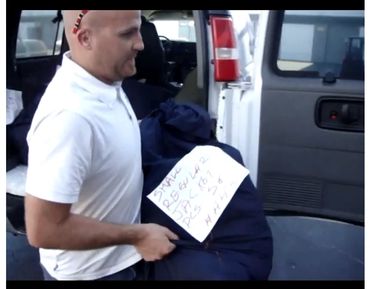
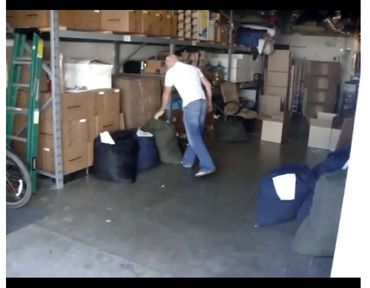
RESPONSE: This is also false and it’s the easiest one to visually disprove.
I am releasing screenshots from a training/operations video that shows Brad Thompson physically delivering product into ROMO’s corporate warehouse environment—not a “band space.” The warehouse is visibly set up for inventory receiving and distribution: racking, cartons, packaged goods, staging, and industrial storage—exactly what a contractor operating a fulfillment and compliance environment looks like. (You can see him carrying deliveries into that warehouse in the screenshots I’m posting.)
And yes—I also have additional warehouse documentation showing the receiving and distribution environment.
RESPONSE: This is a classic subcontractor manipulation tactic: reduce contract performance to only sewing headcount, then claim the prime “did nothing.”
Here are the facts:
In federal contracting, you don’t get paid because you “own a sewing machine.” You get paid because you perform as a contractor under the contract terms—deliver end items that meet spec, with traceable compliance, on schedule, within the rules.
RESPONSE: That is not an accurate statement of how contracting compliance works, and Brad Thompson is not qualified to make it.
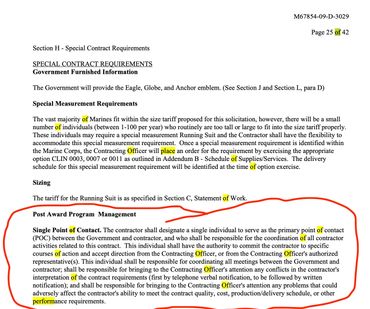
One of the most important factual points the article leaves out is that subcontracting is common and lawful in both commercial and government manufacturing—but the prime contractor remains accountable for performance, compliance, documentation, and delivery. That’s not a loophole. That’s the structure.
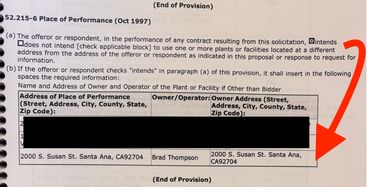
Also: there is evidence showing Brad Thompson’s company was formally identified in relation to performance documentation/proposal coverage associated with the contract (including references tied to places of performance and related clauses). Refer to FAR (Federal Acquisition Regulations) 52.214-24 and 52.215-6
RESPONSE: The article presents a highly dramatic version of events, but leaves out key realities: When a subcontractor attempts to interfere with contract administration or seeks access to information outside the scope of their agreement, the prime contractor has a legal obligation to protect contract execution and maintain the integrity of the procurement.
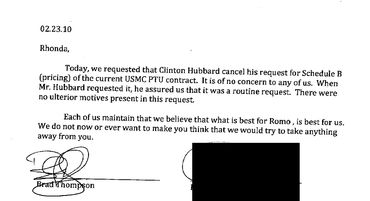
I have documentation showing that Brad Thompson acknowledged in writing that he had no further interest in obtaining pricing information related to the USMC contract. This was not a “fantasy” scenario. It was a documented dispute over access to prime contract pricing.
In fact, Mr. Thompson filed a Freedom of Information Act (FOIA) request in an attempt to obtain pricing and contract documentation, apparently searching for evidence of wrongdoing. That effort did not produce misconduct. Instead, after legal review, his counsel determined that ROMO’s structure and performance were legitimate under the contract. Mr. Thompson subsequently signed written documentation acknowledging his position and stepping back from those claims.
Additionally, no one ever attempted to “buy” Mr. Thompson’s company, despite the dramatic framing in the article. That narrative is false. In reality, Mr. Thompson later purchased the sewing factory from my stepfather. The record reflects a standard business evolution — not a takeover attempt.
The documented facts tell a very different story than the one presented in the article.
The article repeatedly frames ROMO as a “pass-through” scheme. That framing collapses under basic contracting reality.
ROMO paid for and controlled major cost drivers and performance obligations, including:
A subcontractor may cut and sew. But the prime contractor carries the risk and the full accountability. Most don’t understand until they live it: subcontractors often cut corners when nobody is watching. That’s why oversight exists. I watched my supply chain like a hawk because I was the one accountable. Some people resent being managed. Brad Thompson clearly did.
The idea that federal inspectors, quality reps, and contracting offices would funnel millions to a company “doing nothing” is not just wrong—it’s insulting to the system and to the military professionals involved.
I have documentation showing government oversight mechanisms in place, including approvals related to inspection/release procedures within the DFARS framework (which reflects the reality that performance is monitored and governed).
And I have evidence showing SBA 8(a) monitoring and annual review activity—because yes, you are monitored.
This isn’t a casual marketplace. If you can’t document, you can’t survive in contracting.
The title alone is proof the piece is designed to inflame, not inform.
Your sexuality is not a contract term. Your private life is not a performance metric. The inclusion of “lesbian” in the headline isn’t “context”—it’s a tactic.
If the article were genuinely about federal acquisition reform, it would have explained the system cleanly. Instead, it used sexuality, identity labels, and character attacks to sell outrage.
I am not asking anyone to “take my word for it.” I am stating publicly that I have substantial documentary evidence and third-party support, including but not limited to:
I also possess public records documentation, including property and business records associated with Bradley Thompson, that reflect financial and operational outcomes following our professional separation. Those records are not presented for retaliation, but they do provide context when assessing motive and credibility.
I am not publishing every document publicly at this time for legal and privacy reasons. But I am not empty-handed. The evidence exists. It is organized. And it supports the record.
What is most disturbing about this article is not simply that it contains factual inaccuracies. It is that it encourages readers to elevate the narrative of a disgruntled former subcontractor above documented contracting reality, federal oversight mechanisms, and verifiable records.
Brad Thompson’s version of events is not the federal record. It is not the contract file. It is not the oversight documentation. It is his opinion — presented as if it outweighs the United States Marine Corps procurement system itself.
Those who know me professionally and personally are appalled at the way this article defames me — and especially at Brad Thompson’s mischaracterization of both my character and the contracting process. They know how hard I worked, how tightly I ran operations, and how seriously I took compliance, delivery schedules, documentation, and accountability.
If someone wants to pursue federal contracting, they should understand this clearly: it is not easy money. It is rigorous. It is compliance-heavy. It is monitored. It is audited. It demands discipline and documentation. And when the end user is the United States military, lateness and sloppiness are not minor inconveniences — they are unacceptable.
I served my country the way I knew how: by managing performance under strict rules, with real oversight, for real end users who depend on what we deliver.
And I will not allow an angry former subcontractor and a sensationalized headline to rewrite that history.
— Rhonda Valles




RHONDA VALLES

I wrote this book to share what government contracting really looks like from the inside—based on my own experience managing compliance, manufacturing, and federal contracts. If you want a clear, honest breakdown of how it actually works, this is where to start.